
Create Ease In Your Kitchen Through Preparation
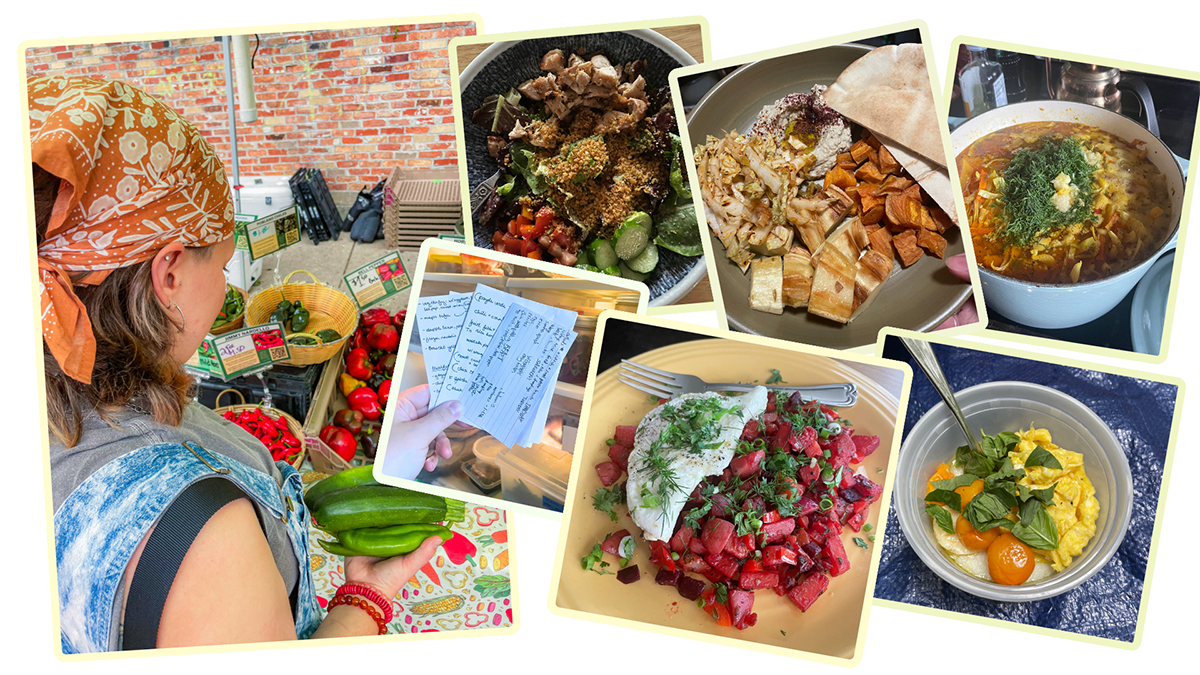
Allison and Her Cooking
You’ve gotten your market finds and brought them home. Now what?
Storing and preparing food is a connection that needs tending. This is easily achieved when working in a commercial kitchen, as it is a constant state of movement and action to prepare food, clean up, and reset for the next. But the home kitchen could become stagnant because it lacks the volume and urgency of a restaurant.
Here’s a few tips from commercial kitchens that you can use at home to organize and connect with your food.
1. Fridge organization:
It can be a challenge. Figuring out how to organize makes preparing food faster and easier. Applying what I learned from kitchens, I have a section for dairy, raw meat, drinks, condiments, vegetables, prepped food that will go into a dish, and ready-to-eat food. Deciding on a place, particularly for prepped and ready-to-eat foods in distinguishable containers, helps eliminate the time spent hunting through the fridge.
2. Label everything:
Restaurants use blue (painter's) tape and a Sharpie to label everything. It’s a great practice. Write what it is and when it was made, and stick it on the front of the container so it’s visible without removing it from the fridge. Often, I think I’ll remember what something is and when I made it, but I am always wrong.
3. Proper produce storage:
It increases shelf life and reduces waste. There are hundreds of guides on the internet that tell you how to store different vegetables. Be cautious of hacks! Tips promising to keep your produce fresh for weeks, like submerging whole produce in water, are typically not good practice.
I like these tips here. It is concise and explains what conditions different types of produce need. For produce needing dry conditions, I use a paper bag. If it needs humidity, I use plastic bags or deli containers. Even when properly stored, you should regularly check your produce for signs of spoilage so you know what to eat next.
Now you’re ready to cook! This is when I start to think about what I want to eat in the coming week. I evaluate my energy, how much time I have, and how hot it’s going to be to decide how ambitious I want my meals to be. I write my meal ideas on an index card. I try to find time on Sunday or Monday to prep components using methods I shared previously.
If you missed the last two market updates, here is the link: